The Challenge
The book opens by confronting a sobering reality: despite decades of change management research and practice, failure rates remain stubbornly high. This persistence of failure signals that traditional approaches are fundamentally inadequate for today's grand challenges. Among these challenges, AI stands out as particularly transformative, reshaping how we work, compete, and create value at a fundamental level while amplifying all other challenges.
The introductory chapter highlights that traditional change management approaches tend to fail us as they assume gradual, predictable transformation. The exponential, nonlinear disruptions of the AI age shatter that assumption. We face an "exponential gap": the widening chasm between how fast AI capabilities evolve and how slowly our organizations, mindsets, planning processes, and governance structures adapt.
Success requires transforming how we think about change itself—moving from discrete projects with clear endpoints to continuous adaptation as an individual and collective capability. The book integrates insights from developmental psychology, systems thinking, complexity theory, organizational design, and AI capabilities research. Throughout, I emphasize practical application: each chapter concludes with actionable tools and frameworks that leaders can implement immediately.
AI Fundamentals
Before diving into change management strategies, the chapter on AI fundamentals provides essential grounding for non-technical leaders. Core technical concepts are explained in accessible terms: deep neural networks as function approximators that learn from data, the transformer architecture's attention mechanism that enables parallel processing and elicits long-range dependencies, and the training of these systems through backpropagation and optimization. This technological foundation enables readers to engage meaningfully with AI opportunities and risks throughout the subsequent chapters.
Individual Change
The premise of the chapter on individual change is that effective change management starts with individual transformation. The primary constraint in navigating complex change isn't technical knowledge but rather the individual's capacity to process complexity, tolerate ambiguity, and continuously reconstruct their mental models. Drawing on Robert Kegan's developmental psychology, three levels of adult consciousness can be distinguished. Most leaders operate with a "socialized mind" shaped by external expectations, or a "self-authoring mind" guided by internal principles. However, the adaptive challenges of the AI age increasingly demand a "self-transforming mind"—one that can hold multiple contradictory perspectives simultaneously, embrace genuine paradox, and view identity itself as fluid rather than fixed. This isn't about accumulating more knowledge but expanding the very structure of consciousness through which we perceive reality.
The book presents several practical frameworks (detailed with implementation guidance in the chapter): Immunity to Change mapping reveals hidden psychological commitments that sabotage change goals; double-loop learning encourages questioning underlying assumptions; personal mastery and growth mindset provide frameworks for continuous learning; meaning-making under pressure (drawing on Viktor Frankl) provides resilience during turbulent transitions; and whole-brain thinking balances analytical strengths with contextual awareness.
AI serves not just as a disruptor but as a developmental tool itself. AI coaches can provide 24/7 support for reflection, offer Socratic questioning, and help leaders test assumptions—democratizing access to developmental support. Specific prompts and protocols illustrate how AI can be used as a thinking partner in your own development.
Organizational Change
The chapter on organizational change demonstrates that resistance to change manifests across three interconnected contexts: (1) Formal context—structures, processes, metrics, and incentive systems that often inadvertently reward old behaviors; (2) Social context—trust levels, communication patterns, and the "psychological contract" between employer and employees; and (3) Mental context—collective mindsets and paradigms, including unspoken commitments to past success formulas that unconsciously sabotage adaptation.
The chapter demonstrates how to use data-driven tools for diagnosing resistance across these contexts. Techniques like sentiment analysis, organizational network mapping, and behavioral tracking reveal where adoption stalls and why. Targeted interventions—differentiated by employee archetype (from "Silent Resisters" to "Anxious Learners" to "Active Opponents")—prove far more effective than uniform change programs. Organizations can use AI itself to manage change: sentiment analysis reveals hidden concerns, predictive analytics identify adoption barriers before they become crises, and AI agents can provide personalized support at scale.
An organizational transformation roadmap includes: comprehensive diagnosis across all three contexts; reshaping structures to align with desired behaviors; strengthening social fabric through psychological safety; challenging mental models through scenario planning; leveraging AI tools for continuous monitoring; and building organizational resilience through redundancy, diversity, and distributed decision-making. Given the current maturity of AI systems, it is important to maintain human judgment while leveraging AI's analytical power—creating "hybrid intelligence" rather than replacement automation.
Societal Change
Organizational success ultimately depends on healthy societal ecosystems. Leaders cannot afford to view their organizations as separate from broader social, political, and economic dynamics—AI renders these interdependencies impossible to ignore. The chapter on societal change draws on complexity theory and historical analysis to explain why societal transitions are often fundamentally nonlinear and path-dependent, crisis-driven rather than gradually managed. This creates both danger (catastrophic tipping points) and opportunity (crises open windows for transformative change).
The concept of "antifragility" becomes crucial at this level. Modern societies, optimized for efficiency, have often become dangerously fragile—witness brittle supply chains during COVID-19, healthcare systems without surge capacity, and financial systems vulnerable to cascading failures. Building societal resilience requires accepting some inefficiency to maintain redundancy, cultivating diversity, ensuring decision-makers bear consequences ("skin in the game"), and maintaining optionality rather than premature optimization.
Leadership in the AI age is unavoidably political—not in partisan terms, but in building coalitions, negotiating between competing interests, creating shared meaning across differences, and forging collective action despite fragmentation. The skills required increasingly resemble statecraft: reading complex stakeholder dynamics, sensing shifts in power configurations, brokering compromises that preserve core values, and communicating vision across diverse worldviews.
Practical tools include agent-based modeling for policy testing, digital twins for scenario simulation, and frameworks for participatory AI governance. However, I consistently stress these are aids for human judgment, not replacements for democratic deliberation.
Societal Impacts of AI
The chapter on the societal impacts of AI dives deeper into AI's broader societal effects. Key areas include:
- Economic disruption and workforce transformation: While AI promises productivity gains, distribution remains deeply uneven. Entry-level positions face particular risk as AI eliminates traditional pathways for skill development.
- The attention economy and manipulation risks: AI-powered recommendation systems optimize for engagement rather than wellbeing, creating "weapons of mass distraction" that affect employee focus, mental health, and organizational culture.
- Privacy erosion and surveillance capitalism: Surveillance infrastructure already exists at scale. Organizations collecting and deploying AI on personal data bear ethical responsibilities that extend far beyond legal compliance.
- Power concentration: AI capabilities, training data, and computational resources are concentrating in a small number of firms and nations, creating "Matthew effects" where those ahead accelerate further ahead.
- Deskilling and expertise erosion: Heavy AI reliance can atrophy human capabilities, creating dangerous dependencies and raising fundamental questions about maintaining human expertise alongside AI deployment.
Central Argument
The book concludes by synthesizing insights across all three levels of change and emphasizing their reflexive interconnections. The following figure visualizes this book's central argument: AI's dual role as both disruptor and enabler across all three interconnected levels of change.
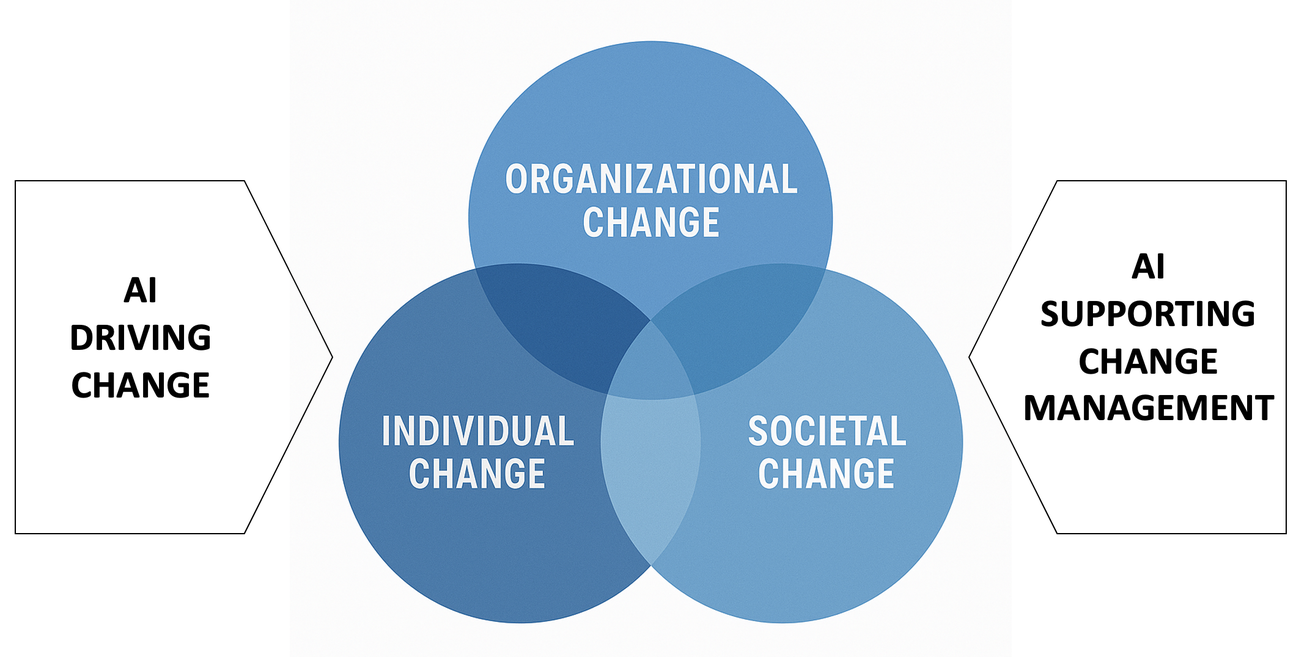
The conclusion reinforces that individual, organizational, and societal transformation are not separate domains but interconnected aspects of a single complex system. An individual leader's expanded consciousness enables organizational innovations previously unthinkable; organizational practices that distribute agency and cultivate learning create environments where individuals can develop; societal investments in education and social cohesion determine what human capital organizations can draw upon. AI makes this integration both more urgent and more complex, as its impacts cascade across all levels.
AI plays a dual role: as the source of disruption requiring new forms of leadership, and as a tool that, properly deployed, enables that leadership to succeed. The task isn't choosing between these possibilities but holding them in productive tension—leveraging AI's capabilities while constraining its risks, using it to amplify human capability while ensuring humans remain genuinely in control.
The book's ultimate message is one of tempered but genuine optimism. The challenges are real and urgent, but human institutions have navigated previous transformations that seemed overwhelming at the time. Success requires abandoning the comfortable fiction that we can predict and plan our way through this transition, and instead building the capacity for continuous learning and adaptation. The age of AI demands nothing less than leadership at its best—technically informed, psychologically aware, organizationally sophisticated, and politically engaged.
Get the Full Book
Purchase "Change Management in the Age of AI" on Amazon to access the complete content, including all chapters, frameworks, and practical tools.
Buy on Amazon →